

covering a damaged rendered plaster wall with plasterboard or drywall

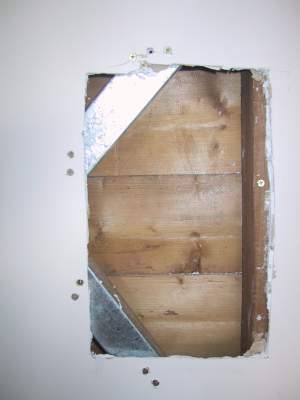
This plaster wall is in bad shape, after an opening has been bricked in.
Covering this with plasterboard, drywall or sheetrock is a straight forward job,
when you know how.

After marking a line where the plasterboard or drywall join will be,
Chip away the painted surface at 450mm centersin the middle of the sheet
and either side of the join. It is best to keep the daubs of adhesive
back a bit from the join.

Cut up plasterboard or drywall blocks as shown.

Apply adhesive in a large blob, to each block and press onto the wall to
where the render is missing.

Notice there is a block either side of the join line, slightly away from the join.

With a straight edge, place it across the blocks, while pressing firmly,
move the straight edge from side to side, until all the blocks are level
with the rendered part ot the wall.

After cutting all the plasterboard or drywall sheets to length, mix up the adhesive
and apply as shown to the blocks and paint free areas.
Normally I would only put the adhesive on for one sheet at a time.
Notice how I apply the adhesive, so the blobs are not so spread out but are
very proud of the surface.

Adhesive spots ready to place the sheet in position,
(except the one missing in the middle)
This was fixed after the photo was taken.

The sheets are placed into position without pressing back too hard. Once all the sheets
are in position, using a straight edge, running diagonally across the sheets
gently tap the sheets back until they are straight.
Keeping the daubs of adhesive at a consitant size makes the leveling of the wall much easier.

The result is a flat wall with the joins perfectly lined up.
Renovating old homes with rendered plaster walls can appear quite difficult. Patching up a rendered plaster wall, like shown here, with sand and cement, will not gaurantee a great finish.
The answer is to stick plasterboard or drywall over the wall to cover up the render, all gaps and cracks.
Where you have un-even surfaces, it is neccessary to glue plaster blocks on the wall to even out the surface before you stick on plasterboard or drywall.
To stick plasterboard or drywall sheet to any masonary surface, you need to use either, cornice adhesive or masonary adhesive. The adhesive needs to be mixed to a fairly stiff but not dry consistancy
Daubs of adhesive should be a uniform size, small in area, but very proud of the wall. This helps to get the sheet level.
Care must be taken when placing the sheets, so that they don't slide on the adhesive daubs. The sheet should be placed into position slightly leaning back towards you. Then gently pushed forward onto the adheasive daubs. Gently pat the sheet into position by hand.
Once all sheets are in positon and patted back. Take a straight edge an tap the sheets firmly onto the wall. The straight edge should be kept diagonal to the sheets or parallel. If you use the straight edge vertically, you could end up with hollow sections in the wall.